.png)
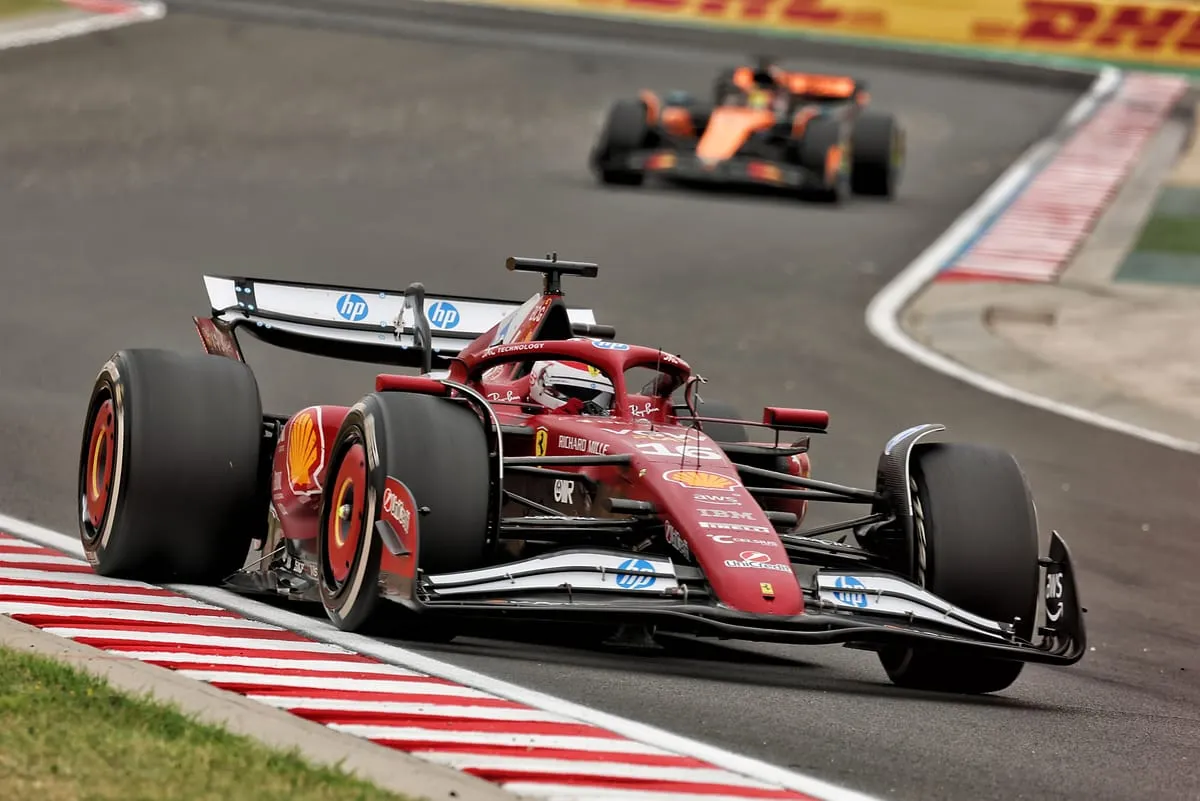
The dramatic pace loss of Charles Leclerc at the Hungarian Grand Prix, which has cost him a possible podium place, has triggered a far reaching investigation of an unspecified issue with the car by Ferrari.
The Monegasque driver won a stunning pole position and led the initial phase, but later experienced an extreme decline in performance in the finale stint to become irrelevant in the race as both McLarens and the Mercedes driver George Russell passed by.
The crew believes that there could be some deeper-rooted chassis or ride height problems that could be the cause of the sudden collapse, and that the team principal, Fred Vasseur, said that the sudden issues with tire wear were more profound than what they usually experience.
Ferrari to Fully Investigate Leclerc's Strange Pace Drop in Hungarian GP
The Hungarian Grand Prix was started with a tremendous promise to Scuderia Ferrari. Charles Leclerc had given himself an amazing qualifying session on Saturday in which he secured the pole position ahead of the McLaren pair of Lando Norris and Oscar Piastri. He took this on to Sunday race, where he was leading the first stages of the 70-lap race at the Hungaroring.
Nonetheless, in the last stint, his SF-25 car failed miserably. The figures demonstrated that about two seconds per lap was lost-a loss that, Vasseur referred to as a slight variation as compared to the normal two to three tenths that would have been anticipated due to control of the tires.
Such poor performance cost Leclerc a place in the race against both drivers of McLaren and ultimately George Russell of Mercedes, depriving him of what seemed to be an easy podium finish.
Firstly, Leclerc thought that the team had completed a front wing adjustment at his second pit stop, which destroyed the balance of the car. Nonetheless, the driver revised this belief upon looking at initial data as there was a more profound, unexplained mechanical problem. The car was simply undriveable, said Leclerc after the race and he underlined how it was of sudden nature and how serious the issue was.
Read also: What Does A Formula 1 Team Principal Do
Technical Failure: Former Ride Height/Chassis Suspicions
Ferrari will put much emphasis on any possible chassis and ride height issues that may report such a drastic loss of performance in the mid race. Principal Fred Vasseur also affirmed the team was investigating whether it had a problem on the chassis side, which implies they believed there was a technical fault and not merely a tactical error.
Historical Background of Plank Wear Problems: Ferrari has been especially on guard about the issue of ride height and plank wear issues as a result of the situation in Chinese Grand Prix race when Charles Leclerc teammate, Lewis Hamilton, was disqualified due to plank wear over the season.
This is a violation of the rule and ensures that teams must have a minimum ride height to ensure that the titanium skid block, or plank, on the bottom of the car is not overly worn.
Normal Mitigation Procedures: To prevent additional disqualification, Ferrari has developed conservatism in races that are likely to wear heavily. These are having the minimal rise of the car ride height, lowering the engine power settings on the long straits (the car will bottom out the worst at these speeds), and increasing of tire pressure.
These measures are expensive to performance, but they are typically computed and translate into a slight predictable loss in pace.
Suspected Anomaly: Leclerc has a two-second downside which is a indication that there is something that went beyond these routine protocols. The team is examining the possibility that an unplanned, radical change in the ride height or aerodynamics of the car was brought about by an unforeseen mechanical event a component failure of the chassis or the suspension.
Exterior Views: Competitor Team Analysis.
Ferrari struggled in front of other grid teams. George Russell of Mercedes who later sneaked past Leclerc on the final podium position provided an incisive analysis to Sky Sports. He opined that the aggressive set up of Ferrari finally caught them up.
Russell said that the only clue they could have as to why they were running the car so low it was almost to the ground, was that they would have to raise the tyre pressures to the final stint.
He also observed that Ferrari was levering on a lower engine mode at the end of the straights, a particular strategy of minimizing plank wear, which was in line with what his team had been witnessing of Ferrari and his continued ride height problems.
Conclusion and Recommendations to Ferrari
To Ferrari and Charles Leclerc, the incident can be described as a wasted opportunity. The Hungaroring is a circuit where the performance of cars, and not the brute force of the engine actually matters, and the pole position of Leclerc was the indication that San Francisco-25 had the necessary speed. It was important to translate that into a win or a podium to secure championship points and to be motivated.
Investigation History: The group has handed over its cars and equipment to its factory in Maranello. It will be done through a complete forensic teardown and data analysis of the chassis of Leclerc (probably reference chassis number 05), where thousands of data points of the first and final stint will be compared to determine the point of failure.
Driver Confidence: Leclerc also said he was very certain that the problem happened once, and that it should not and will not happen in the future, as he told the media, we have to investigate what happened so that it will never happen again. Nevertheless, it is of paramount importance that there is no underlying flaw in the design that will guarantee him about the reliability of the car throughout the rest of the season.
Championship Impact: Each lost podium has an effect to Constructors and Drivers Championships. Although Ferrari is still in a close with McLaren and Mercedes, such unforeseen losses can make a season. Such a problem will be one of the major tests of the technical operating power of the team since it will require the rapid diagnostics and permanent correction of the issue.