.png)

When a Formula 1 car crashes, the bill can be shocking. Repair costs can range from a few thousand dollars for a damaged front wing to well over a million dollars for a major accident. This incredible expense comes down to one primary factor: the car is built almost entirely from advanced carbon fiber composite materials.
Understanding the financial impact of an F1 collision requires looking at the price of parts, the skilled labor needed to fix them, and the team's strict racing budget cap constraints. Let's explore what goes into the carbon fiber repair cost analysis after a crash.
F1 Car Crash Damage Calculator – Carbon Fiber Repair Cost Analysis
Why Crashes Create Such Eye-Watering Bills
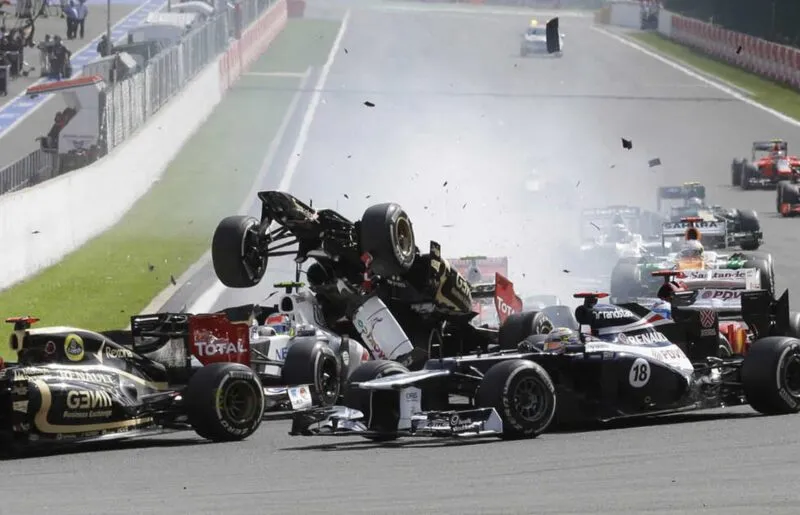
Formula 1 cars are not just fast; they are incredibly complex and fragile machines built for one purpose: maximum performance. Every part, from the tip of the nose to the rear wing, is designed to be as light and strong as possible. This means that in a crash, parts don't just bend; they often shatter or crack, becoming useless for racing.
The main reason for the high cost is the material. Carbon fiber monocoques and bodywork are expensive to make but vital for safety and speed. A single piece, like a front wing, can cost up to $150,000. In a big crash where the car hits a wall sideways.
Damage can reach the gearbox (around $600,000) or even the engine, which costs many millions. For example, a significant crash for Max Verstappen in 2021 was reported to have cost his team about $1.8 million.
A Breakdown of F1 Car Component Costs
To understand where the money goes, here is a look at what it can cost to replace key parts of an F1 car, especially after a severe accident.
Estimated Cost to Replace Major F1 Car Components
| Component | Estimated Replacement Cost |
|---|---|
| Front Wing Assembly | $280,000 |
| Rear Wing with DRS | $150,000 |
| Chassis / Monocoque | $200,000 |
| Floor | $140,000 |
| Gearbox | $350,000 |
| Halo | $15,000 |
| Power Unit (Engine) | ~$4,500,000 |
| Total for a Destroyed Car | ~$6 Million |
These numbers show why a single bad crash can be a huge problem for a team. Under the F1 financial regulations and budget cap, teams have a limited amount of money (around $135 million per season) to spend on everything: building the car, paying staff, traveling to races, and fixing crash damage. A $1 million crash eats up a big chunk of that cap, leaving less money to develop faster parts later in the season.
Carbon Fiber: The Miracle Material That Costs a Fortune
What Makes Carbon Fiber So Special and So Pricey?
Carbon fiber is a woven material that, when set in a special resin and cured under high heat and pressure, becomes incredibly strong and very light. This perfect strength-to-weight ratio is why it's used everywhere in F1. However, the process of making it is why it's so expensive.
First, the raw materials are costly. About half of the initial material is burned away during production, instantly doubling the base cost. The manufacturing process itself is like rocket science. It involves many steps like carbonization (baking fibers at extreme temperatures), precise weaving, and curing parts in giant ovens called autoclaves.
Each step requires expensive machines, lots of energy, and highly skilled technicians to do the work by hand. Unlike bending a metal fender back into shape, you can't just hammer out a dent in carbon fiber.
Also read :- Formula 1 Upcoming Races : Latest F1 Schedule & Race Dates
The Different Types of Carbon Fiber Damage and Repair
Not all damage is the same. A carbon fiber repair specialist first carefully analyzes the part to understand the extent of the "hurt." They look for different types of damage:
-
Surface Damage: This includes chips and scratches only in the clear glossy coat. It's the simplest and least expensive to fix.
-
Structural Cracks: These are cracks in the carbon fiber layers themselves. They affect the part's strength and must be carefully repaired by adding new layers of carbon fiber.
-
Major Damage: This is when the part is badly broken or misshapen. Repairing it might require special tools, 3D scanning, or even creating a new mold to rebuild a section.
As one composite technician with 20 years of F1 experience notes, minor repairs might happen at the track, but most damaged parts are sent back to the factory where specialists can do detailed work in a controlled environment.
The High-Pressure World of F1 Crash Repairs
The Race Against the Clock
In Formula 1, time is the most precious resource. The process to rebuild an F1 car after a major incident is a carefully choreographed ballet. When a damaged car arrives in the garage, a large team of specialists springs into action.
Mechanics focus on the mechanical parts—suspension, brakes, gearbox. Composite technicians, the masters of carbon fiber, take over the bodywork, wings, and chassis. They work together, following a strict plan to get the car ready for the next session.
Sometimes, they have only a couple of hours between practice sessions. The team might even work overnight, a special allowance they can use only a few times a year.
Inspection is Everything: Finding Hidden Hurt
Before any repair, technicians must find all the damage. This is where Non-Destructive Testing (NDT) is critical. As an NDT engineer explains, a lot of impact damage, like tiny cracks or delamination (layers separating), is invisible to the eye.
Technicians use special tools like ultrasound machines to "see" inside the carbon fiber, just like a doctor uses an ultrasound to look inside a body. This ensures that every weak spot is found and fixed. No team can risk a repaired part failing at 200 miles per hour.
Estimating the Damage: The Concept of a Crash Cost Calculator
What Factors Would an F1 Damage Calculator Consider?
While there isn't a public online calculator for F1 crashes, we can think about what one would include. A real F1 collision expense estimator would be very complex, but key inputs would be:
-
Parts Damaged: The biggest cost driver. A front wing vs. a full chassis replacement is the difference between $150,000 and $200,000.
-
Labor Intensity: How many hours will the skilled composite technicians and mechanics need?
-
Budget Cap Impact: It would calculate what percentage of the team's total season budget this crash consumes.
This is different from a standard car crash force calculator, which estimates physical forces on passengers. An F1 tool is all about the financial and operational impact on the team.
Real-World Season Damage Totals
We can see this "calculator" in action by looking at real-season data. Driver damage costs are tracked. Some drivers are very clean; for instance, Esteban Ocon had only about $280,000 in damage for a whole season. Others have tougher years. In 2021, Mick Schumacher's crashes cost the Haas team over $4 million in repairs.
These totals highlight a big point of debate: teams must pay for damage to their own car from their budget cap, even if another driver caused the crash. This makes avoiding accidents, even small ones, a crucial part of a driver's job.
Carbon Fiber Repair vs. Replacement: Making the Tough Call
When Can Carbon Fiber Be Repaired?
For less severe structural cracks, professional carbon fiber restoration is possible and can save money compared to buying a brand-new part. The process involves carefully preparing the area, building up new layers of carbon fiber patch, and curing it to restore strength. For visible areas on show cars, experts can even re-skin the part with a new layer of carbon weave to hide the repair.
When is a Part Beyond Repair?
Sometimes, the damage is too great. If the core structure is shattered or the part is badly twisted, it cannot be safely repaired. In these cases, the only option is a costly F1 component replacement. Teams carry a supply of critical spare parts, like wings and suspension, to trackside. For a major part like a chassis, they may have a complete spare tub ready. If not, building a new one at the factory becomes a time-critical emergency.
Key Takeaways and Final Thoughts
The world of F1 carbon fiber crash economics teaches us that speed has an immense price. The pursuit of lightness and strength leads to cars made of exotic, expensive materials that are difficult and costly to fix. Every crash has a carbon fiber repair cost analysis, affecting their performance for the rest of the season.
For fans, this adds another layer of drama to the race. That small tap between rivals isn't just about position; it could mean a $150,000 wing is destroyed. The brave work of the composite technicians and mechanics in the garage is as much about saving money as it is about saving the race weekend. In Formula 1, finance and physics are forever racing side-by-side.
FAQs: Your Formula 1 Crash Cost Questions Answered
Who pays for the damage when an F1 car crashes?
The team that owns the car pays for all the repair costs out of its own budget. The driver does not pay the bill. The money comes from the team's overall funds, which include money from sponsors and prizes.
Are F1 cars insured against crash damage?
No. Formula 1 cars are not insured for damage that happens on the track during a race or practice session. The risk of a crash is too high, and the costs are too great for insurance companies. Cars are usually only insured for things like theft or damage during transport between races.
What is the most expensive part to replace on an F1 car?
The power unit (the engine) is by far the most expensive single component, costing several million dollars. The hybrid system is incredibly complex. The gearbox is also very costly, at around $350,000. Among the body parts, the front and rear wings are among the priciest.
How long does it take to repair a badly crashed F1 car?
It depends on the damage. For a major crash that breaks the chassis, it can take days at the factory. For significant track-side damage, teams have performed miracles, like fully repairing a car in just 20 minutes between sessions. More commonly, a big repair job between practice sessions might take the whole team working 2-3 hours non-stop.