.png)
When a small yellow light turns on in your car, you may feel worried. That light looks like an engine. Many people call it the check engine light. You do not need to go to a repair shop right away. You can find out what is wrong by yourself. You just need a small tool called an OBD2 scanner. This article will teach you how to use that tool. You will learn how to read obd2 scanner codes. You will also learn how to read live data. And you will get free solutions for your car codes. This guide works for most cars made after 1996. It also has special tips for Ford owners.
Do not be afraid of the check engine light. It is not a sign that your car will break down today. It is just your car trying to talk to you. The car has a small computer. That computer checks how the engine works. When something is not right, the computer saves a code. The code is like a clue. Your job is to read that clue and find the problem.
What is an OBD2 scanner?
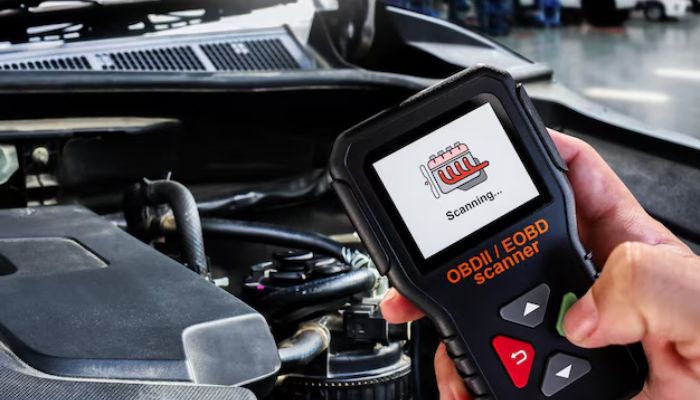
OBD2 stands for on-board diagnostics, second generation. That is a long name. But the tool is simple. It is a small device that plugs into your car. One end of the tool has a plug that fits into a port in your car. The other end has a screen or a place to connect your phone. When you turn on the scanner, it talks to your car computer. Then it shows you the codes that your car has saved.
Some scanners are cheap. You can buy one for twenty dollars. Some scanners are expensive and do many things. But for most people, a basic scanner is enough. That basic scanner will show you the code number. Then you can look up what that number means. You do not need to spend a lot of money to find out why your check engine light is on.
You may also read :- 2026 Car Repair Estimator: Calculate Service Costs Online
Where to Find the Plug in Your Car?
Before you can read codes, you need to find the plug. Car makers call this plug the diagnostic link connector. But you can just call it the OBD2 port. It is usually under the dashboard on the driver side. Get in the driver seat and look down near your knees. Look near the steering column. The port is shaped like a trapezoid. That means it is wider on one end and narrower on the other. It has sixteen small holes in it.
If you cannot find it near the steering wheel, look in other places. Some cars have the port behind a small door. Some cars have it near the hood release handle. Some cars have it near the center console. If you still cannot find it, look in your car manual. The manual will show you a picture of where the port is.
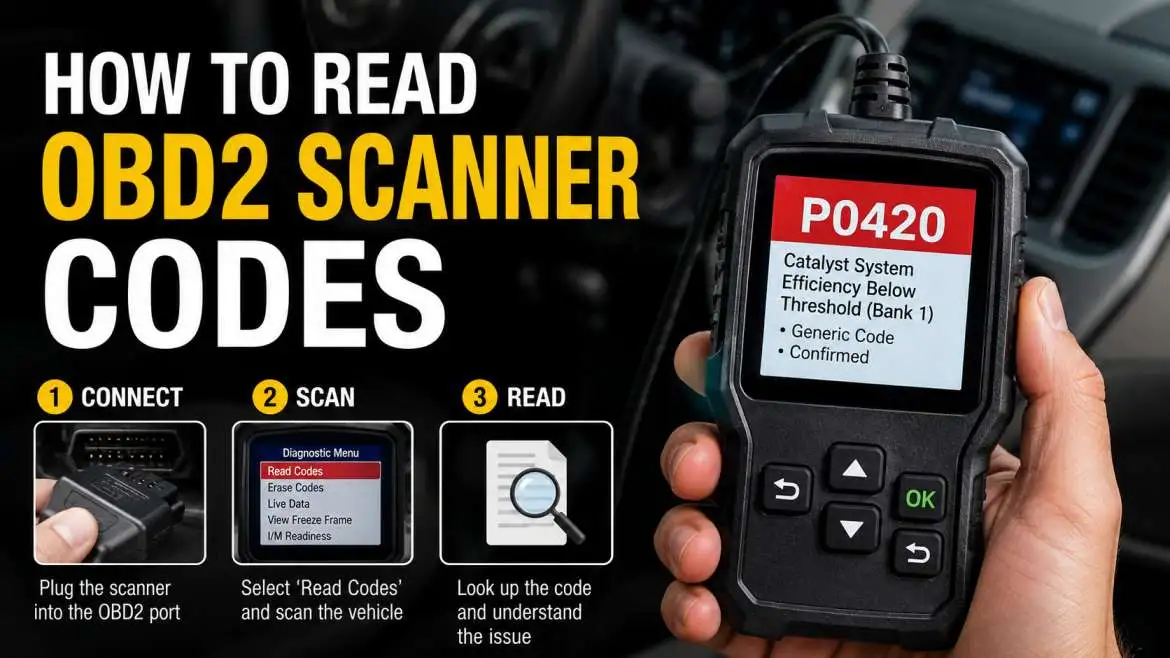
How to Read OBD2 Scanner Codes Step by Step?
Now comes the main part of this guide. Follow these steps one by one. You will be reading your own codes in less than five minutes.
Step One: Get Your Scanner Ready
Take your OBD2 scanner out of its box. If your scanner needs batteries, put them in. Some scanners get power from the car. Those do not need batteries. Read the small paper that came with your scanner. That paper will tell you if your scanner has a power button or if it turns on by itself.
Step Two: Turn the Car Key
Sit in the driver seat. Put the key into the ignition. Turn the key to the on position. Do not start the engine. The on position is the place where all the lights on your dashboard turn on. You will hear a small beep and see the check engine light and other lights turn on. This gives power to your car computer without running the engine.
Step Three: Plug in the Scanner
Take the end of the scanner that has the sixteen pins. Push it into the OBD2 port in your car. It will only go in one way. Do not force it. If it does not go in easily, turn the plug the other way. Once it is in all the way, you may hear a small click.
Step Four: Turn on the Scanner
If your scanner has a power button, press it. Many scanners turn on by themselves when you plug them in. Look at the screen. It should light up and show words or numbers. If nothing happens, check that your car key is in the on position. Also check that the scanner is pushed in all the way.
Step Five: Find the Read Codes Button
Look at the buttons on your scanner. Find the button that says read or scan. Some scanners have a button that says code. Press that button. The scanner will start talking to your car computer. You may see a message that says connecting or link. Wait a few seconds.
Step Six: Write Down the Codes
After the scanner finishes talking to the car, it will show you one or more codes. Each code has a letter and four numbers. For example you might see P0300 or P0420. Write down every code that you see on a piece of paper. If you see more than one code, write them all down in order.
Step Seven: Look at Different Types of Codes
Some scanners will show you different lists. One list might say stored codes. These are active problems. These codes keep the check engine light on right now. Another list might say pending codes. These are problems that happened but are not happening right now. Pending codes may turn on the light later if the problem comes back. Another list might say history codes. These are old problems that have been fixed. The car remembers them but they are not active anymore. Focus on the stored codes first. Those are the most important.
Step Eight: Turn Off and Unplug
After you write down all the codes, you can turn off the scanner. Unplug it from the car. Then turn off the car key. You now have the codes you need to start fixing your car.
Understanding What the Code Letters Mean
The first letter of the code tells you which system in your car has the problem. This is easy to learn.
If the code starts with the letter P, the problem is in the powertrain. The powertrain is your engine and your transmission. Most codes start with P because the engine is the most common place for problems.
If the code starts with the letter B, the problem is in the body. The body includes your airbags, your power windows, and your air conditioner.
If the code starts with the letter C, the problem is in the chassis. The chassis includes your brakes, your suspension, and your anti lock brake system.
If the code starts with the letter U, the problem is in the network. The network is how the different computers in your car talk to each other.
So when you see a code like P0171, you know right away that something in your engine or transmission needs your attention.
How to Read OBD2 Scanner Live Data?
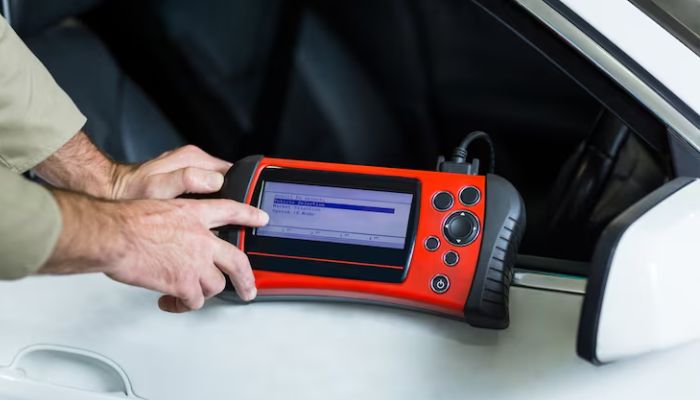
Reading codes is good. But you can learn even more from live data. Live data is a stream of numbers that change in real time. It shows you exactly what your car sensors are seeing right now. This helps you find problems that do not turn on the check engine light. It also helps you confirm that a fix worked.
What You Need to See Live Data
Not every basic scanner shows live data. If you want to see live data, you need a scanner that has that feature. Some cheap scanners only read codes. Better scanners have a button that says "live data" or "data stream." If you have a Bluetooth adapter that connects to your phone, most phone apps will show you live data for free.
How to Get to Live Data
Plug in your scanner the same way you did before. Turn the car key to the on position. You can also start the engine for live data. Some sensors only work when the engine is running. On your scanner, look for a button or menu that says live data. Press it. You will see a list of sensor names. Each name has a number next to it. That number is the live reading from that sensor.
Five Important Things to Watch in Live Data
You do not need to look at every sensor. That would be too many numbers. Focus on these five things. They tell you the most about your engine health.
Engine Coolant Temperature
Look at this number. It tells you the real heat of your engine. After you drive for a while, the engine gets warm. A good warm engine runs between 70 and 105 degrees Celsius. If you use Fahrenheit, that is 160 to 220 degrees. What if the number is too low? That means your engine is cold when it should be hot. Your thermostat is probably stuck open. That part lets water flow all the time. So the engine never gets fully warm.
What if the number is too high? That is bad. Your engine is getting too hot. You may see steam or smell something burning. You need to stop driving and check your coolant. What if the number never moves at all? For example, it always says 40 degrees. Even after you drive for twenty minutes. That means the sensor is dead. It is not reading anything. You need a new sensor.
Engine RPM
RPM stands for revolutions per minute. That is just a fancy way of saying how many times your engine spins in one minute. You do not need to remember the fancy name. Just watch the number. When your car is parked and your engine is fully warm, look at this number. It should stay very steady. Most cars sit between 600 and 900 RPM. It should not jump around.
If the number jumps up and down, you have a problem. The engine revs up, then drops down, then revs up again. That usually means you have a vacuum leak. Air is getting into the engine where it should not. Or your idle air control valve is dirty. That valve controls the air when your foot is off the gas. If the number is too high, your engine is spinning too fast at a stop. You should not hear your engine roaring when you are sitting at a red light. That is a sign of a bad idle air control valve.
Short Term Fuel Trim
This number looks strange. But it is easy to understand. Your car wants to mix air and fuel in a perfect balance. That perfect balance is called fourteen point seven parts air to one part fuel. Your car computer watches the exhaust and changes the fuel every second to keep that balance. The short term fuel trim number shows you those small changes. Think of it like this. Zero means perfect balance. The car does not need to change anything.
If you see a positive number, your car is adding more fuel. For example plus five or plus ten. That means the car thinks there is too much air. So it throws in extra fuel to catch up. Too much air often comes from a vacuum leak. A hose is cracked or loose.
If you see a negative number, your car is taking away fuel. For example minus five or minus ten. That means the car thinks there is too much fuel. So it pulls fuel back. Too much fuel often comes from a leaking injector. That injector drips gas when it should not. A good engine shows a number between negative five and positive five. If you see numbers bigger than that, you have a problem to find.
O2 Sensor Voltage
The oxygen sensor is a small part that screws into your exhaust pipe. Its job is to sniff the exhaust after the engine burns the gas. It checks how much oxygen is left. This sensor sends out a voltage. When you watch live data, you will see that voltage move. It should go up and down. Up to nine tenths of a volt. Down to one tenth of a volt. Back and forth. Back and forth. It should never stay still.
If the voltage stays at one tenth, your sensor is saying there is a lot of oxygen. That means the engine is running lean. Not enough fuel.
If the voltage stays at nine tenths, your sensor is saying there is almost no oxygen. That means the engine is running rich. Too much fuel.
If the voltage stays right in the middle at five tenths, the sensor is dead. A dead sensor does not move. It just sits there. You cannot fix a dead sensor. You have to replace it.
Intake Air Temperature
This sensor is a small probe inside your air intake tube. That is the big plastic pipe that brings air to your engine. The sensor measures how hot or cold that air is. Here is a simple way to test it. Start your car in the morning before you drive anywhere. Look at the intake air temperature number. Then look at the outside temperature. The two numbers should be close. Maybe a few degrees different. That is fine.
What if the intake air temperature number is way off? For example, it is sixty degrees outside. But your sensor says one hundred twenty degrees. That sensor is lying. It is bad.
A bad intake air temperature sensor causes problems. Your car computer uses that number to decide how much fuel to add. If the computer thinks the air is very hot when it is actually cold, it will add the wrong amount of fuel. That makes your car use too much gas.
How to Use Live Data to Find Problems?
Live data is not just for watching numbers. You can use it to test parts. For example if you think you have a vacuum leak, look at the short term fuel trim. Spray a small amount of brake cleaner around the rubber hoses under the hood. If the fuel trim number suddenly drops, you found your leak. If you think you have a bad oxygen sensor, watch the voltage. It should switch back and forth. If it stays flat, the sensor needs to be replaced.
Ford-Specific Method to Read Codes Without a Scanner
This part is for Ford owners. Some Ford cars have a secret way to show codes on the dashboard. You do not need any tool at all. This works on many Ford cars made between 2000 and 2016. This includes the Ford Focus, Ford F-150, Ford Escape, and Ford Mustang from those years.
Steps for the Ford Odometer Method
Get in your Ford and close the door. Make sure all lights and the radio are off. Put the key in the ignition. Turn the key to the off position. Look at your dashboard. Find the button that resets your trip odometer. That is the small button near the speedometer.
Press and hold that trip button. Do not let go. While you are holding the button down, turn the key to the on position. Do not start the engine. Keep holding the button. Watch the odometer display. After about fifteen seconds, you will see dashes on the screen. That is a line that looks like this --. Keep holding.
After about thirty seconds, the odometer will start flashing numbers. Each number is a code. For example you might see 0300 or 0420. Write down each code as it appears. The codes will repeat. When you see the same code twice, that means you have seen all the codes. Then you can let go of the button and turn off the key.
This method does not work on every Ford. It works on many but not all. If your odometer never shows codes, you need a normal OBD2 scanner. But it is always worth trying because it costs nothing.
Free Car Diagnostic Codes List and Solutions
Now you have your codes. You need to know what they mean. And you need to know how to fix them. Here are the most common codes you will see. For each code, you get a simple meaning and a cheap first step to try before you buy any parts.
P0300 Random Misfire
This code means your engine is misfiring. That means one or more cylinders are not burning fuel correctly. You may feel shaking when the car is running. First step is to check your spark plugs. Take out each spark plug and look at it. If the tip is worn down or has black dust, replace the plugs. Spark plugs are cheap. While you are there, look at the rubber coil boots. If they have white dust or cracks, replace those too. Many misfires go away after new spark plugs.
P0171 System Too Lean
This code means your engine is getting too much air and not enough fuel. Your car computer tries to add more fuel to fix it. But the computer can only add so much. First step is to check for vacuum leaks. Look at all the rubber hoses under the hood. Find the hose that goes from your air filter box to your engine. That hose is big and black. Look for cracks or holes. Also listen for a hissing sound when the engine is running. A hiss means air is leaking in. You can fix small cracks with electrical tape as a temporary fix.
P0420 Catalyst Efficiency Low
This code means your catalytic converter is not cleaning the exhaust as well as it should. This converter is an expensive part. Do not buy a new one yet. First step is to check your oxygen sensors. Use your scanner to watch the downstream oxygen sensor voltage. That is the sensor after the converter. If that sensor looks the same as the upstream sensor before the converter, the problem may be a bad sensor. Replace the downstream sensor first. It costs much less than a converter. Many times this fixes the code.
P0442 Evap Leak Small
This code means there is a small hole in your fuel system. Fuel vapors are escaping. This is the most common code of all. First step is to tighten your gas cap. Get out of the car and walk to the gas cap. Turn it until you hear three clicks. That is the proper tightness. Then use your scanner to clear the code. Drive the car for a few days. The code will probably stay off. If the code comes back, you may need a new gas cap. A new gas cap costs ten dollars.
P0301 to P0308: Cylinder-Specific Misfire
These codes are like P0300, but they tell you exactly which cylinder is misfiring. P0301 means cylinder one. P0302 means cylinder two. And so on. First step is to swap parts. Take the coil from the cylinder that has the code and move it to a different cylinder. Clear the code and drive. If the code moves to the new cylinder, you need a new coil. If the code stays on the same cylinder, you may have a bad fuel injector or low compression.
How to Clear the Codes After You Fix the Problem
After you try the first step solution, you need to clear the codes from your car computer. This turns off the check engine light. If the light comes back, the problem is still there.
To clear codes, plug your scanner back into the car. Turn the key to the on position. Look for a button that says clear or erase. Press it. The scanner will ask you to confirm. Say yes. You will see a message that says codes cleared or done. Then unplug the scanner. Start your car. The check engine light should be off.
Sometimes the light does not turn off right away. Some cars need to drive a few miles before the light goes off. That is normal. The car computer is running tests to make sure the problem is really gone.
Where to Find Free Code Lookup Tools
You do not need to pay for code definitions. There are free tools that help you understand any code. The best free tool is the OBDII car fault codes app. You can download it on your phone. It has a list of every code. It tells you the meaning and common fixes. Another good free tool is the RepairSolutions2 app from Innova. Even if you do not buy their scanner, you can still use the app to look up codes. It shows you verified fixes from real mechanics.
You can also use a normal internet search. Type your code number into the search bar followed by the word fix. For example type P0300 fix. You will find many forum posts and videos from people who had the same code. Read a few different sources before you decide what to do.
Final Words
Reading OBD2 codes is not hard. You do not need to be a mechanic. You just need a cheap scanner and this guide. The check engine light is your friend. It tells you when something is wrong early. Early problems are cheap to fix. Late problems are expensive. Do not ignore that yellow light. Read the code. Try the cheap first step. Clear the code. Drive your car and see if the light comes back. Most of the time, the cheap fix works.
You now know how to read codes. You know how to read live data. You have a free list of common codes and solutions. You even know a Ford trick that costs nothing. The next time that yellow light turns on, you will not feel worried. You will feel ready. Go get your scanner and find out what your car is trying to tell you.